
Victoria to New South Wales Interconnector West (VNI West) is a proposed new high-voltage electricity transmission project that would strengthen the connection between Victoria and New South Wales. It would improve access to renewable electricity and storage and support a secure and reliable electricity supply for Victorians during the energy transition.
VNI West is required to complete an Environment Effects Statement (EES), and obtain relevant Victorian and Commonwealth approvals, before construction can begin. An EES describes the proposed project, its rationale, potential environmental and social effects and how VicGrid VNI West proposes to avoid, mitigate or manage environmental effects. The Victorian Department of Transport and Planning (DTP) administers the process on behalf of the Minister for Planning.
The VNI West EES is prepared in accordance with the Ministerial guidelines for assessment of environmental effects under the Environment Effects Act 1978 (Vic) and the scoping requirements issued by the Minister for Planning. A draft Planning Scheme Amendment (PSA) GC316 is also being prepared in accordance with the Planning and Environment Act 1987 (Vic).
The proposed easement for VNI West will not be finalised until the Minister for Planning has completed the Minister’s assessment of the EES and any matters raised through the assessment and approvals process have been addressed.
Environment Effects Statement interactive map
View the VNI West EES interactive map and photomontages, a form of digitally enhanced photography showing how the proposed transmission infrastructure may appear in the landscape, as detailed in the Landscape and Visual Impact Assessment (Technical Report - Appendix J).
Step 1
Select view location
Step 2
Select photomontage
Step 3
Proposed view
Note: Proposed transmission infrastructure may not be visible in Step 3 where views are blocked or obscured by vegetation, buildings or other objects.
Environment Effects Statement documents
Explore summaries of the technical studies prepared for the VNI West EES.
Loading...
-
Non-technical summary
-
Executive summary
-
Electric and magnetic field
-
Air quality
-
Landscape and visual
-
Noise and vibration
-
Climate change and greenhouse gas
-
Ecology
-
Bushfire
-
Agriculture
-
Business and economics
-
Land Use and planning
-
Social
-
Historic heritage
-
Aboriginal cultural heritage
-
Geology and soils
-
Groundwater
-
Surface water
-
Traffic and transport
-
Aviation
There are 29 chapters in the EES. The first seven chapters cover the project rationale, project development, the legislative and assessment framework, and stakeholder and community engagement.
These are followed by twenty technical chapters outlining the investigations undertaken as part of the assessment. The EES also includes a chapter on environmental management during construction and operation, and a final chapter presenting the overall conclusions.
Table of contents PDF
Glossary and abbreviations PDF | Word
Executive Summary PDF
Chapter 1: Introduction PDF | Word
Chapter 2: Project rationale PDF | Word
Chapter 3: Project development and alternatives PDF | Word
Chapter 4: Project description PDF | Word
Chapter 5: Legislative framework PDF | Word
Chapter 6: Assessment framework PDF | Word
Chapter 7: Stakeholder and community engagement PDF | Word
Chapter 8: Electric and magnetic field PDF | Word
Chapter 9: Geology and soils PDF | Word
Chapter 10: Groundwater PDF | Word
Chapter 11: Historic heritage PDF | Word
Chapter 12: Bushfire PDF | Word
Chapter 13: Climate change PDF | Word
Chapter 14: Surface water PDF | Word
Chapter 15: Greenhouse gas PDF | Word
Chapter 16: Air quality PDF | Word
Chapter 17: Landscape and visual PDF | Word
Chapter 18: Traffic and transport PDF | Word
Chapter 19: Noise and vibration PDF | Word
Chapter 20: Agriculture PDF | Word
Chapter 21: Aviation PDF | Word
Chapter 22: Business and economics PDF | Word
Chapter 23: Land use and planning PDF | Word
Chapter 25: Aboriginal Cultural Heritage PDF | Word
Chapter 26: Ecology PDF | Word
Chapter 27: Matters of National Environmental Significance PDF | Word
Chapter 28: Environmental management framework PDF | Word
The 19 technical appendices contain detailed information about the investigation conducted on the matters raised in the scoping requirements. These in-depth impact assessments have been prepared by specialists on topics like biodiversity, groundwater, surface water, noise, traffic, and agriculture.
VNI West Appendix A Electric and magnetic field PDF
VNI West Appendix B Geology and soils PDF
Part 1 | Part 2 | Part 3 | Part 4
VNI West Appendix C Groundwater PDF
VNI West Appendix D Historic Heritage PDF
Part 1 | Part 2 | Part 3 | Part 4
VNI West Appendix E Bushfire PDF
VNI West Appendix F Climate change PDF
VNI West Appendix G Surface water PDF
VNI West Appendix H Greenhouse gas PDF
VNI West Appendix I Air quality PDF
VNI West Appendix J Landscape and visual PDF
Part 1 | Part 2 | Part 3 | Part 4 | Part 5 | Part 6
VNI West Appendix K Traffic and transport PDF
Part 1 | Part 2 | Part 3 | Part 4
VNI West Appendix L Noise and vibration PDF
VNI West Appendix M Agriculture PDF
VNI West Appendix N Aviation PDF
VNI West Appendix O Business and economics PDF
VNI West Appendix P Land use and planning PDF
VNI West Appendix Q Social PDF
VNI West Appendix R Aboriginal Cultural Heritage PDF
Part 1 | Part 2 | Part 3 | Part 4 | Part 5 | Part 6 | Part 7
VNI West Appendix S Ecology PDF
Part 1 | Part 2 | Part 3 | Part 4 | Part 5 | Part 6 | Part 7 | Part 8
To support the technical assessments and the chapters there are six additional attachments.
Attachment I: PSA Planning Report PDF
Attachment II: Stakeholder and Community Engagement Report PDF
Attachment III: Draft Offset Strategy PDF
Attachment IV: EES Map Book PDF
Attachment V: Comparative Assessment of Overhead and Underground Transmission Technologies PDF
Attachment VI: Detailed Project development and alternatives PDF
The VNI West EES summary documents provide an overview of the project, including its potential effects and the measures proposed to manage them.
Accessible versions of the EES summary documents are also available below. These versions have been prepared to improve access for people with disability and people who use assistive technologies, such as screen readers.
EES non-technical summary PDF | Word (accessible)
Executive summary PDF | Word (accessible)
Aboriginal cultural heritage PDF | Word (accessible)
Agriculture PDF | Word (accessible)
Air quality PDF | Word (accessible)
Aviation PDF | Word (accessible)
Business and economic PDF | Word (accessible)
Climate change and greenhouse gas PDF | Word (accessible)
Ecology PDF | Word (accessible)
Electric and magnetic fields PDF | Word (accessible)
Geology and soils PDF | Word (accessible)
Groundwater PDF | Word (accessible)
Historic heritage PDF | Word (accessible)
Key topic areas Word (accessible)
Land use and planning PDF | Word (accessible)
Landscape and visual PDF | Word (accessible)
Noise and vibration PDF | Word (accessible)
Social PDF | Word (accessible)
Surface water PDF | Word (accessible)
Traffic and transport PDF | Word (accessible)
Environment Effects Statement progress
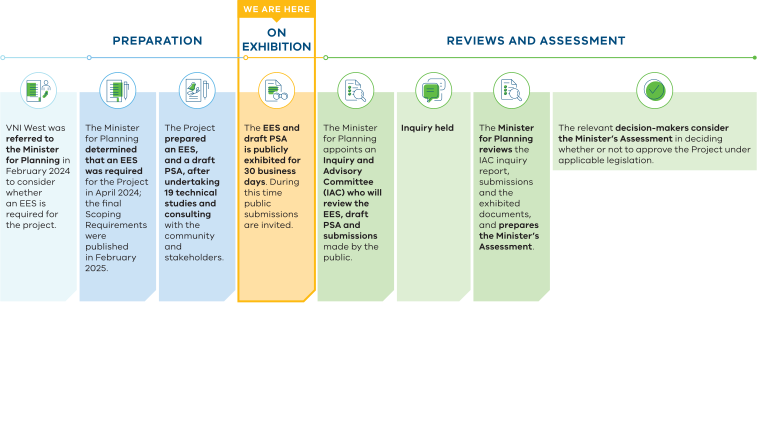
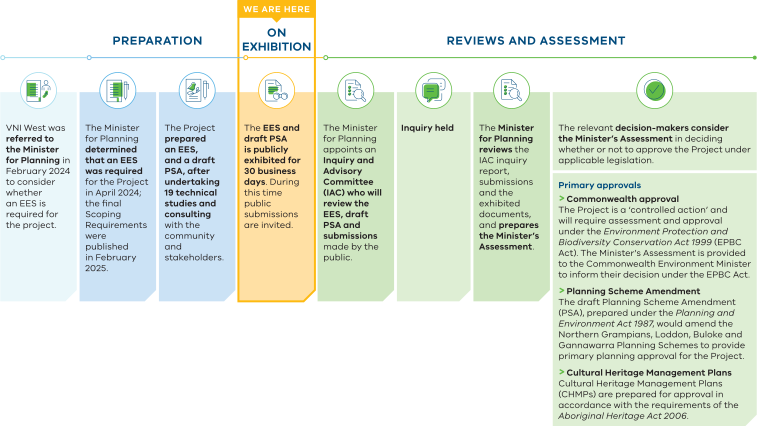
The EES process assesses the potential environmental and social effects of VNI West and informs subsequent project approval decisions. The diagram below outlines each stage of the process, including public review and the Minister for Planning’s assessment.
Exploring the Environment Effects Statement
Not sure where to start? The non-technical summary introduces the project, the EES process and public exhibition, while the Executive Summary provides an overview of the EES assessments and key findings. You can also explore our additional resources explaining the EES, public exhibition and submission processes.
Environment Effects Statement audio summaries
Prefer to listen? Explore narrated sections of the VNI West EES Executive Summary, including information about the technical assessments, key findings and proposed mitigation measures.
Loading...
Ask questions about the Environment Effects Statement
{{ activityStatus ? $t("activityStatus.open") : $t("activityStatus.closed") }}
{{ activityCloseText }}
Have a question about VNI West, technical studies or the EES process? Use the Ask a Question button and our team will respond.
To ask a question you must create an account or log in.
These are the people that are listening and responding to your questions.

VicGrid VNI West
The VicGrid VNI West project team brings together expertise across environmental, planning, engineering and technical disciplines, supported by specialist advice and assessment through the project’s Technical Advisory Service, AECOM.
Duplicate question
Open question
Answered question
Question with unpublished answer
{{ question.upVotes }} votes |
{{ question.views ? question.views : 0 }} views
{{question.description}}
Unpublished Answer
Answer
No questions found
Further information
Learn more about the draft Planning Scheme Amendment and other approvals required for VNI West, or find a community event near you to speak with the project team.